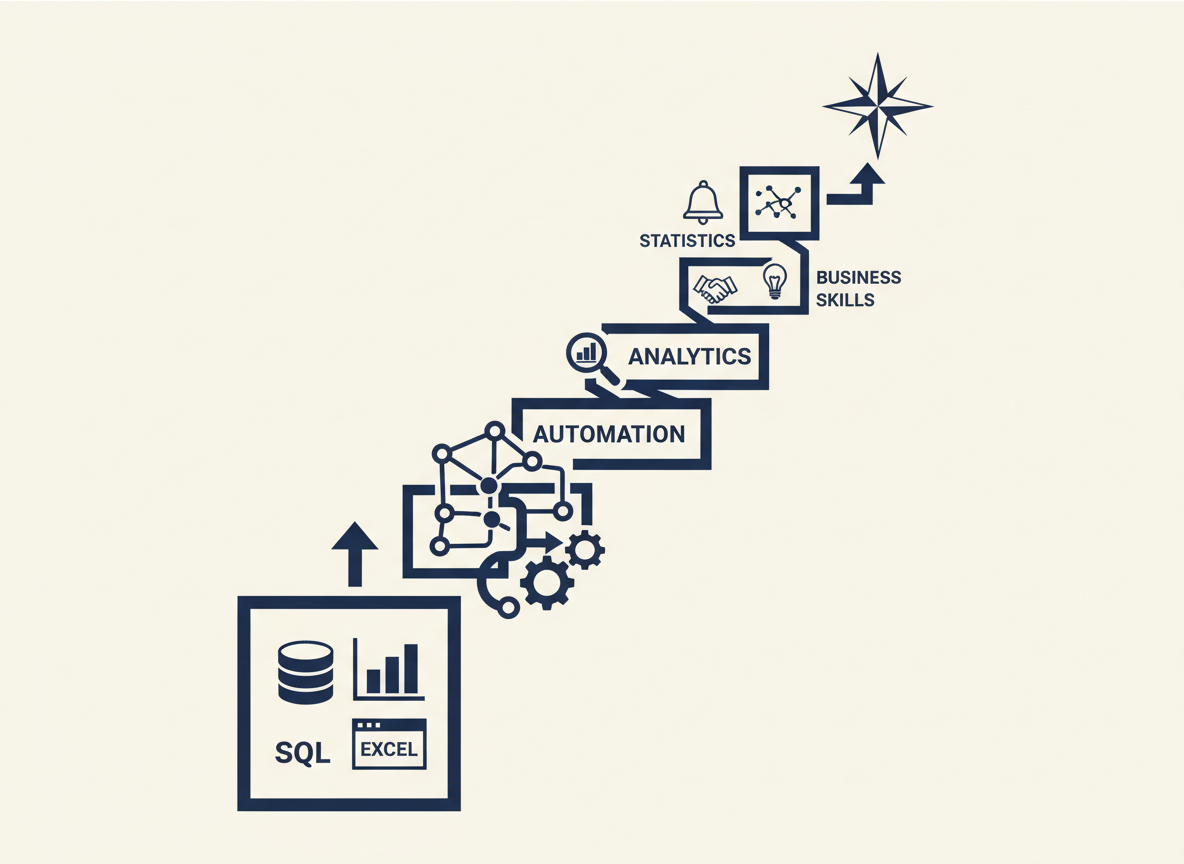
Once SQL, Excel, Power BI, and basic Python are familiar, the next step is usually deeper analytical judgment—not collecting an endless list of tools.
1. Strengthen SQL
Move beyond syntax into data modeling, grain, window functions, reconciliation, performance, and reliable metric definitions.
2. Learn practical statistics
Focus on distributions, sampling, confidence intervals, correlation, regression basics, hypothesis testing, and interpreting uncertainty.
3. Understand data modeling
Learn fact and dimension tables, relationships, keys, and how modeling choices affect reporting.
4. Automate repetitive work
Use Python, SQL, spreadsheets, scheduled workflows, or BI refreshes to reduce manual preparation—and add validation to the automation.
5. Build business context
Understand the economics and operating logic of your domain. Better context leads to better questions before the analysis starts.
6. Improve communication
Practice explaining findings in three layers: what happened, why it matters, and what should be investigated next.
7. Build evidence of impact
Show reduced manual effort, improved data quality, faster reporting, clearer decisions, or stronger controls rather than collecting certificates without evidence.
A useful progression
Foundation → analytical depth → execution → business impact → AI-assisted work with verification.