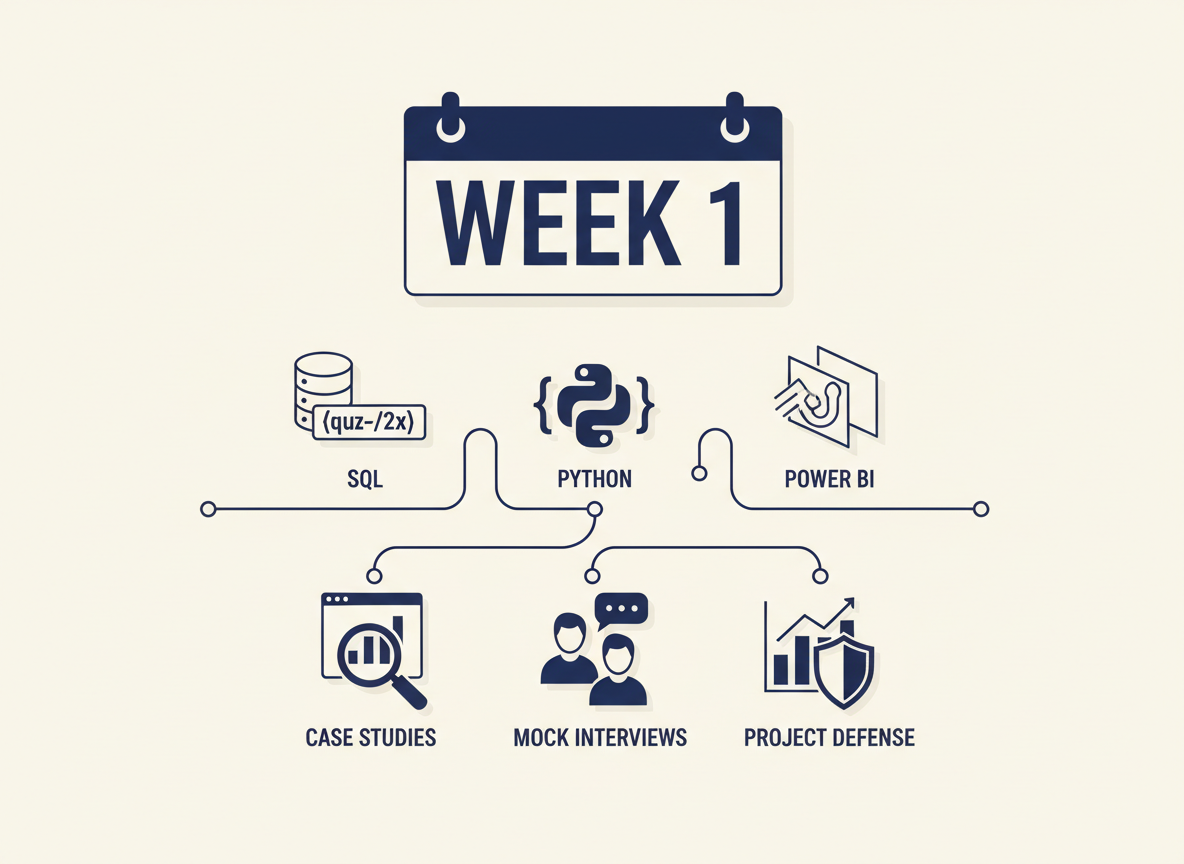
This is a practice system rather than another question bank. It uses timed retrieval, mock interviews, project defense, and weakness repair.
Days 1–3: SQL fundamentals and debugging
Practice filtering, aggregation, joins, CTEs, windows, dates, nulls, and deduplication. Explain why the query works.
Days 4–5: Business cases
Take an ambiguous KPI change. Define the metric, ask clarifying questions, segment the problem, and propose validation.
Day 6: Python
Practice loading, filtering, grouping, joining, missing-value handling, reshaping, and basic visualization while explaining your reasoning.
Day 7: Power BI
Review relationships, measures, filter context, dashboard design, and core DAX concepts. Explain why each visual belongs.
Days 8–9: Project defense
Prepare two projects using problem, ownership, data, approach, validation, result, trade-off, and lesson.
Day 10: Behavioral stories
Prepare evidence-based examples for ambiguity, disagreement, failure, prioritization, automation, and learning.
Days 11–12: Timed mocks
Mix SQL, a case, project questions, and behavioral questions. Review structure, clarity, and evidence.
Day 13: Weakness repair
Identify the two weakest areas from your mocks and focus on those instead of repeating what you already know.
Day 14: Full simulation
Run one complete interview without notes. Turn every slow or uncertain answer into the next revision list.
The rule
Practice retrieval and explanation, not passive reading. Interview preparation should simulate the constraints of the interview itself.